> For the complete documentation index, see [llms.txt](https://user.netmera.com/netmera-user-guide/llms.txt). Markdown versions of documentation pages are available by appending `.md` to page URLs; this page is available as [Markdown](https://user.netmera.com/netmera-user-guide/customer-data/about-customer-data.md).
# About customer data
Customer Data connects identity, behavior and consent into one data layer for campaigns, journeys and automation.
Netmera provides **Customer Data** as a module for capturing, unifying, and using information about users.
Customer Data acts as a **data layer** that connects identity, behavior, and consent. This data is used by campaigns, journeys, and automation within Netmera.
### Explore customer data
### Profile attributes
Profile Attributes are structured fields that describe each user. You can store anything from basic contact info to custom traits like membership level, favorite category, or device type.
* Create custom attributes tailored to your business
* Auto-update via SDKs, APIs, or contact uploads
* Use in segmentation, personalization, and journey triggers
### Device metadata
Netmera captures device metadata to support engagement. With this data, you can:
* **Deliver tailored content** by adapting messages to device, OS, and location.
* **Segment with precision** using attributes like app version, region, or language.
* **Gain deeper insights** with analytics by platform, version, and manufacturer.
* **Troubleshoot faster** by identifying issues across specific devices or OS versions.
### Events
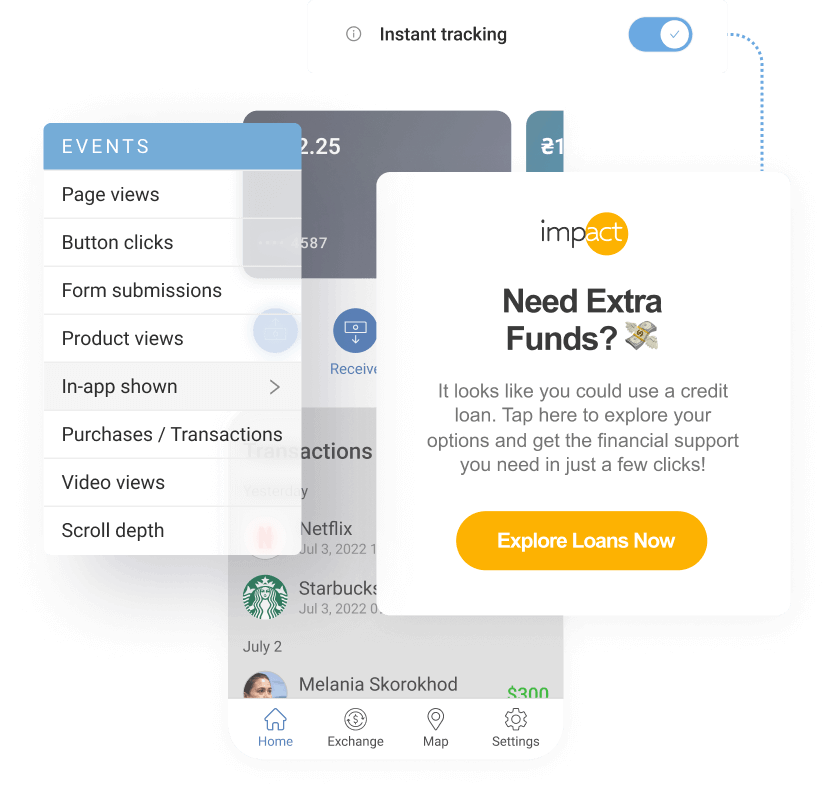
Events capture user actions like button clicks, logins, purchases, or onboarding steps. These signals are used for behavioral targeting and automation logic across Netmera.
* Built-in and custom event tracking
* Parameter support for richer data
* Visualize user actions in Event Insight
### Tagless data capture
Tagless Data Capture gathers behavioral data from your website or app automatically, reducing the need for manual tagging and code.
### Why customer data powers the whole platform
Customer Data is a shared source of information for Netmera's engagement features.
Every attribute, event, and permission feeds directly into Netmera’s:
* Campaign targeting
* Audience segmentation
* Journey triggers
* Personalization logic
* Message eligibility filters
* and advanced analytics
Customer Data provides the starting point for engagement as well as a source for reporting and analysis.
---
# Agent Instructions
This documentation is published with GitBook. GitBook is the documentation platform designed so that both humans and AI agents can read, navigate, and reason over technical content effectively. Learn more at gitbook.com.
## Querying This Documentation
If you need additional information that is not directly available in this page, you can query the documentation by asking a question.
Perform an HTTP GET request on the following URL with the `ask` and `goal` query parameters:
```
GET https://user.netmera.com/netmera-user-guide/customer-data/about-customer-data.md?ask=&goal=
```
`ask` is the immediate question: it should be specific, self-contained, and written in natural language.
`goal` is what the user is ultimately trying to achieve, the reason they need the answer. Sharing it helps GitBook give you a better, more relevant answer. A goal is most helpful when it describes the outcome the user wants rather than restating the question. For example, with `ask=how do I create an API token`, a goal like `automate deployments from our CI pipeline` lets GitBook tailor the answer to that use case.
The response will contain a direct answer to the question and relevant excerpts and sources from the documentation.
Use this mechanism when the answer is not explicitly present in the current page, you need clarification or additional context, or you want to retrieve related documentation sections.