
| Purpose | Mobile Push | SMS | |
|---|---|---|---|
| Promotions | Opted out | Opted in | Opted out |
| Order Updates | Opted in | Opted in | Opted in |
| Security Alerts | Opted in | Opted in | Opted in |
| General channel permission | Category + channel preference | Result |
|---|---|---|
| ON | ON, or no record on an Opt-in category | Delivered |
| ON | No record on an Opt-out category | Blocked until the user opts in |
| ON | OFF | Blocked for this category only. Other categories on the same channel are unaffected. |
| OFF | ON | Blocked |
| OFF | OFF | Blocked |

| Channel | Default state |
|---|---|
| Mobile Push | ON |
| ON | |
| SMS | ON |
| ON | |
| In-App | ON |
| Web Push | ON |


| Subscription Type | Users with no record | What is stored |
|---|---|---|
| Opt-in (default) | Subscribed | Only the users who opted out |
| Opt-out | Not subscribed | Only the users who opted in |
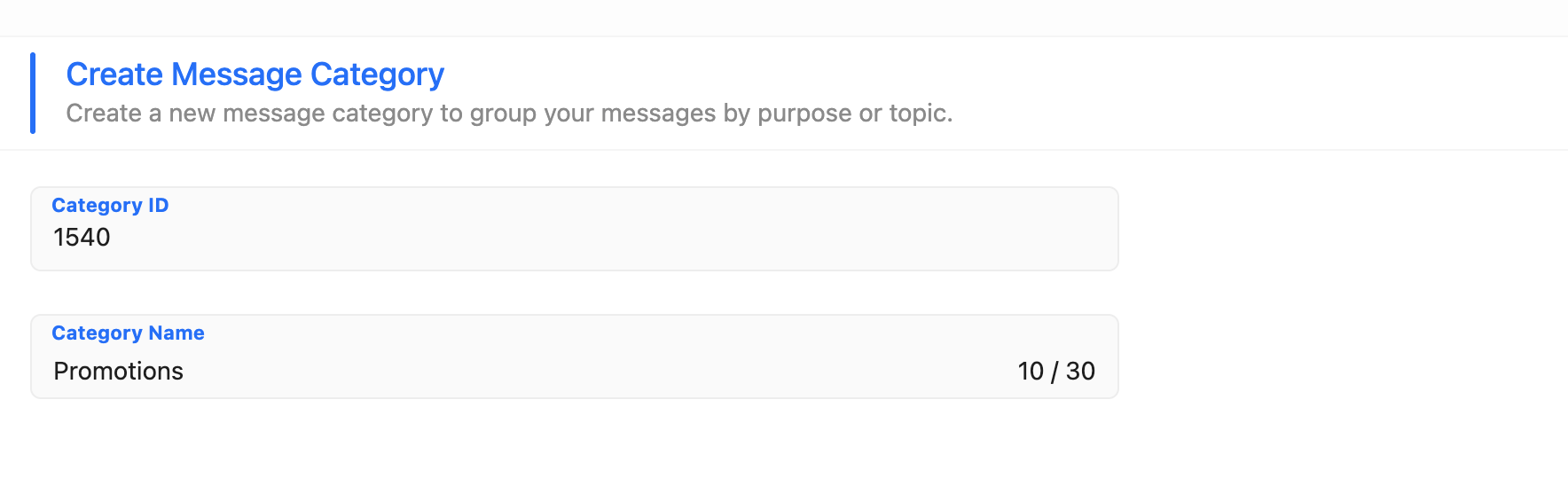
Category ID and Name
| Category Name | Channels | Mobile Push Opt-in | Mobile Push Opt-out | Email Opt-in | Email Opt-out | SMS Opt-in | SMS Opt-out |
|---|---|---|---|---|---|---|---|
| order_tracking | Push, Email | 1,250 | 24 | 1,180 | 94 | - | - |

| Channel | Opt-in Users | Opt-out Users |
|---|---|---|
| Mobile Push | -1 | +1 |
| No change | No change | |
| SMS | No change | No change |
| No change | No change | |
| In-App | No change | No change |
| Web Push | No change | No change |
| Campaign channel | Categories listed |
|---|---|
| Mobile Push | Categories with Mobile Push selected, plus legacy categories |
| Categories with Email selected, plus legacy categories | |
| SMS | Categories with SMS selected, plus legacy categories |
| Categories with WhatsApp selected, plus legacy categories | |
| In-App | Categories with In-App selected, plus legacy categories |
| Web Push | Categories with Web Push selected, plus legacy categories |
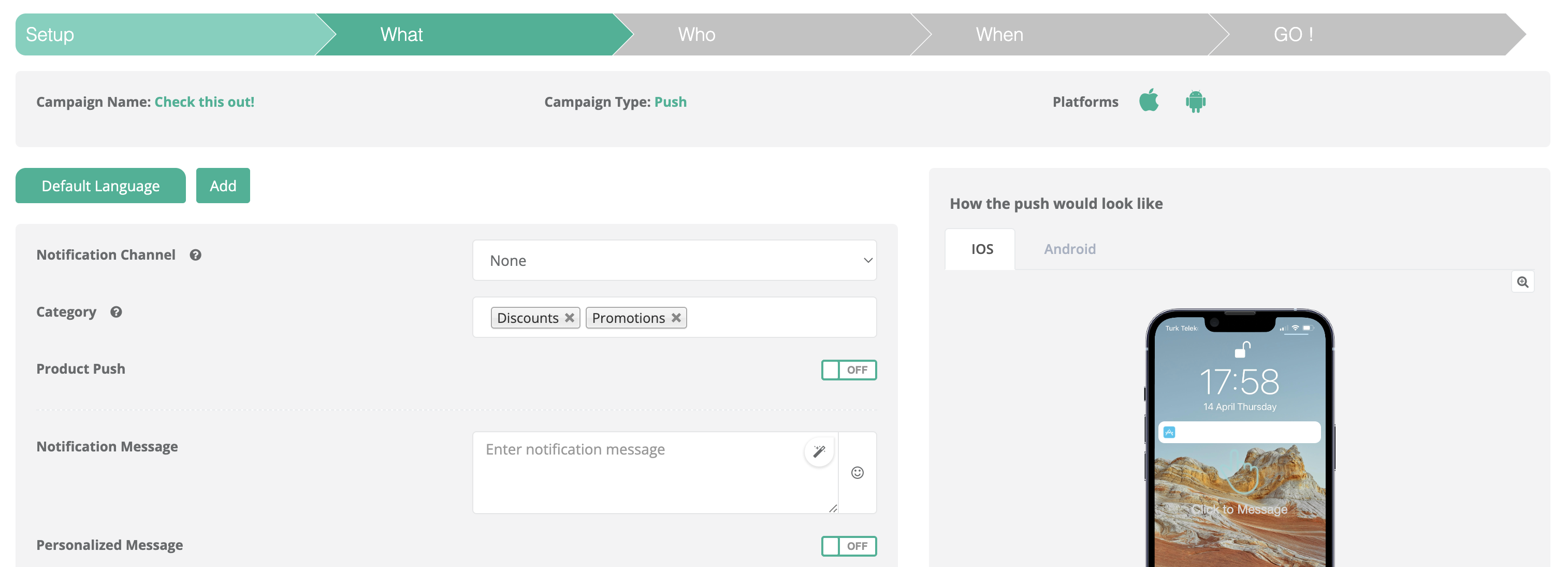
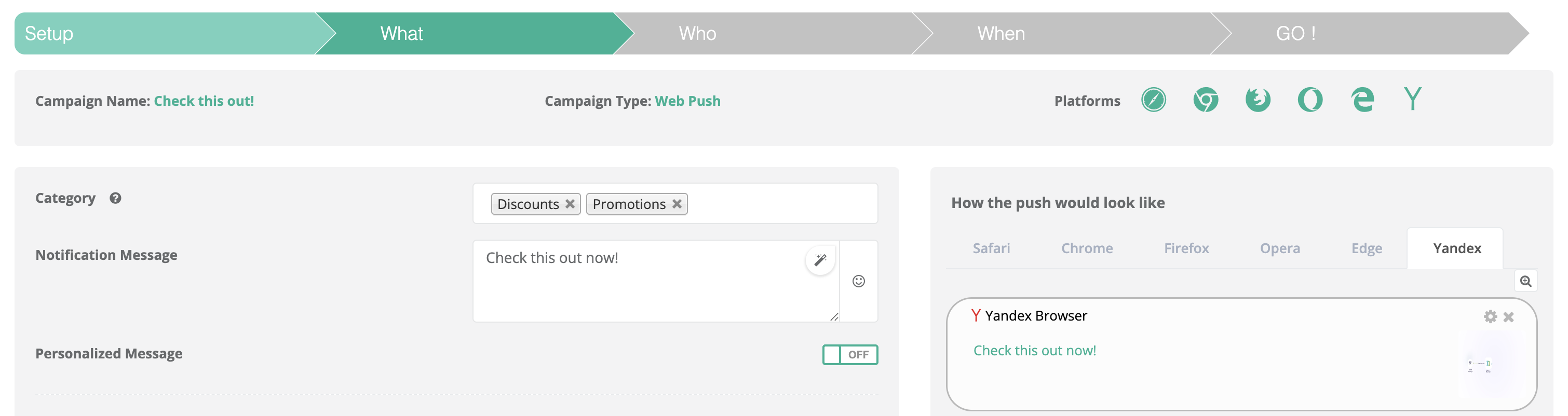
Select a category in the campaign flow


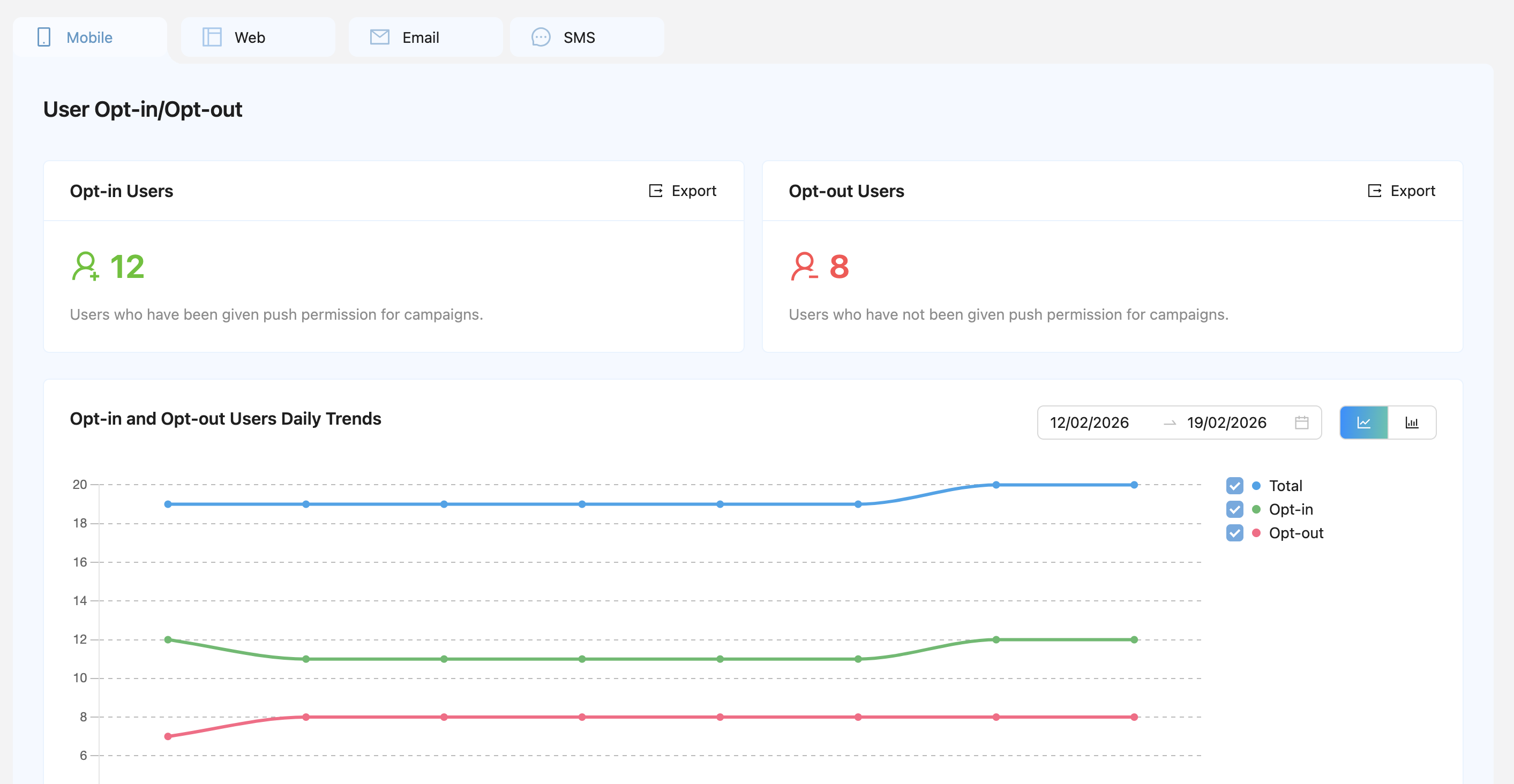
| Category | Mobile Push | SMS | In-App | Web Push | ||
|---|---|---|---|---|---|---|
| Category X | Toggle | Toggle | Disabled | Disabled | Disabled | Disabled |


| Endpoint | What it does | Developer Guide |
|---|---|---|
GET /rest/3.0/getPushCategories | Lists the categories defined under Settings > Message Categories. The returned names and IDs are used by the other endpoints. | Push Categories |
POST /rest/3.0/setCategoryPreferences | Opts a user in or out of a category, for all channels or for one channel with channel. | Category Preferences |
GET /rest/3.0/getCategoryPreferences | Returns a user's category preferences with a per-channel breakdown. Can be filtered with categoryIds and channels. | Category Preferences |
POST /rest/3.0/sendBulkNotification | Assigns one or more categories to a notification sent by API through the categories field. | Send Notification with Category |
POST /rest/3.0/createNotificationDefinition | Assigns categories to a transactional notification definition through the categories field. | Notifications |
| Platform | Methods | What they do | Developer Guide |
|---|---|---|---|
| Android | getUserCategoryPreferenceList, setUserCategoryPreference | Read and update the user's category preferences. Channel-level read and write with NMCategoryPreferenceFilter, NMCategoryPreferenceUpdate, and NMCategoryChannel (4.21.0+). | Android — Message Categories |
| iOS (Swift) | getUserCategoryPreferenceList, setUserCategoryPreference | Read and update the user's category preferences. Channel-level read and write with categoryIds, channels, and channel parameters (4.26.0+). | iOS — Manage Push Notification Categories |
| iOS (Objective-C) | getUserCategoryPreferenceList, setUserCategoryPreferenceWithCategoryId | Read and update the user's category preferences at category level. | iOS (Objective-C) — Message Category |
| Flutter | getUserCategoryPreferenceList, setUserCategoryPreference | Read and update the user's category preferences at category level. | Flutter — Push Inbox |
| Source | Who changes the preference | Typical trigger |
|---|---|---|
| Mobile SDK | The user | In-app preference center or notification settings screen |
| REST API | The brand, on the user's behalf | CRM or consent-management platform sync, web preference center, email unsubscribe page, SMS keyword reply, call center request |
| Panel | The brand | Manual correction or support request in User Detail |
| Platform | Minimum version | Get preferences | Update preferences |
|---|---|---|---|
| Android | 4.21.0 | Netmera.getUserCategoryPreferenceList(filter, callback) with NMCategoryPreferenceFilter | Netmera.setUserCategoryPreference(NMCategoryPreferenceUpdate, callback) |
| iOS (Swift) | 4.26.0 | Netmera.getUserCategoryPreferenceList(categoryIds:channels:) | Netmera.setUserCategoryPreference(categoryId:categoryEnabled:channel:) |
| Article | Principle | How Message Categories support it |
|---|---|---|
| Art. 4(11) | Consent is specific, informed, and unambiguous | Each category + channel pair is a separate, specific decision |
| Art. 5(1)(b) | Purpose limitation | Categories represent purposes; campaigns must declare one |
| Art. 5(1)(c) | Data minimisation | Categories can be restricted to the channels the purpose needs |
| Art. 5(1)(d) | Accuracy | REST and SDK keep the Netmera record aligned with decisions made in other systems |
| Art. 6(1)(a) | Consent as a lawful basis | Opt-out Subscription Type prevents sending before an explicit opt-in |
| Art. 7(1) | Ability to demonstrate consent | Per-channel states are visible in User Detail and retrievable through getCategoryPreferences |
| Art. 7(2) | Consent request clearly distinguishable | Separate categories for marketing and service messages |
| Art. 7(3) | Withdrawal as easy as giving consent | One toggle or one API call withdraws consent for a single purpose on a single channel |
| Art. 21(2)–(3) | Right to object to direct marketing | A marketing opt-out on a channel is enforced on the next send |
| Art. 25(2) | Data protection by default | Opt-out Subscription Type defaults new users to not subscribed |
| Recital 32, 43 | Consent per purpose; separate consent for separate operations | Consent is stored per category and per channel |