> For the complete documentation index, see [llms.txt](https://user.netmera.com/netmera-user-guide/llms.txt). Markdown versions of documentation pages are available by appending `.md` to page URLs; this page is available as [Markdown](https://user.netmera.com/netmera-user-guide/omnichannel-engagement/mobile-push/personalized-mobile-push.md).
# Personalized mobile push
Personalize mobile push title, message and subtext with user data such as name, cart or loyalty values.
{% columns %}
{% column width="58.333333333333336%" %}
Personalized mobile push lets you tailor the **title**, **message**, and **subtext** with user-specific data.
Use it when the push should feel relevant to the recipient, such as:
* greeting the user by name,
* reminding them about a saved item or abandoned cart,
* or inserting loyalty, promotion, or profile-based values.
{% endcolumn %}
{% column width="41.666666666666664%" %}
{% endcolumn %}
{% endcolumns %}
### Quick workflow
{% stepper %}
{% step %}
#### 1) Prepare the user data
Make sure the profile attributes you want to use already exist in Netmera.
{% endstep %}
{% step %}
#### 2) Insert attributes in Step 2: What
Use the `{@attribute}` format, or select an attribute and click **Add**.
{% endstep %}
{% step %}
#### 3) Choose the fallback behavior
Decide what should happen when a user does not have that attribute.
{% endstep %}
{% step %}
#### 4) Preview before sending
Check the final wording so the message still reads naturally after substitution.
{% endstep %}
{% endstepper %}
### Before you start
Before you personalize a push, make sure the required user data already exists in Netmera.
Typical attributes include:
* `name`
* `surname`
* `age`
* `loyaltyTier`
* `favoriteCategory`
You can also insert promotion values when your campaign depends on a promotion assignment.
{% hint style="warning" %}
#### Personalization needs data first
If an attribute is missing for a user, the personalized text cannot be resolved for that user.
Set up the data first in:
* [Profile Attributes](/netmera-user-guide/customer-data/profile-attributes.md)
* [Coupon Code Lists](/netmera-user-guide/panel-settings/settings/messaging-and-content/coupon-code-lists.md) — if you want to include promotion or coupon-related values
{% endhint %}
### How personalization works
In **Step 2: What**, you can insert profile attributes directly into supported fields.
Use the `{@attribute}` format, or select an attribute from the dropdown and click **Add**.
Example:
* **Default message:** `Happy birthday!`
* **Personalized message:** `Happy {@age}th birthday, {@name}!`
* **Rendered result:** `Happy 26th birthday, Simon!`
{% hint style="info" %}
Keep the message readable even after substitution. Short, natural text performs better than heavily templated copy.
{% endhint %}
### Where you can personalize
You can personalize three common fields in mobile push:
* **Title** — best for the main hook
* **Message** — best for context and details
* **Subtext** — best for a short secondary value
### Personalized title
Use a personalized title when the first line needs stronger relevance.
Common use cases:
* `{@name}, your order is ready`
* `Hey {@name}, your offer expires today`
* `{@loyaltyTier} member reward unlocked`
This is useful for improving open rates when the user’s identity or status adds immediate context.
### Personalized message
Use **Personalized Message** for the main body of the push.
This is the best place to add dynamic details such as:
* product names,
* profile values,
* coupon or loyalty information,
* or next-step reminders.
Example:
* `Hi {@name}, the items in your cart are still waiting.`
* `Your coupon code is {@couponcode}.`
Preview
### Personalized subtext
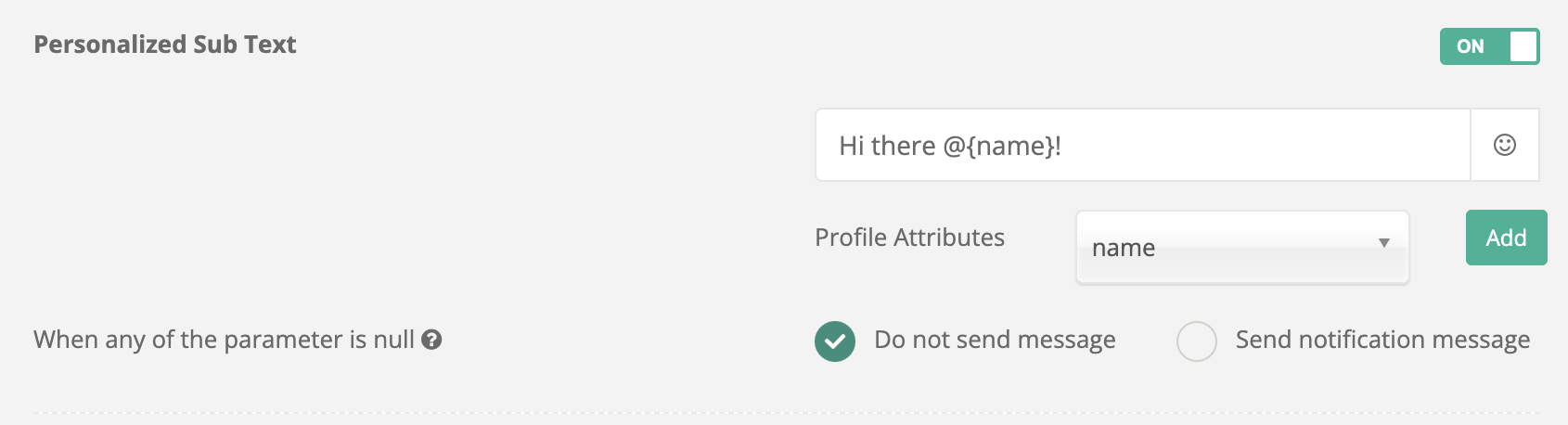
Use **Personalized Subtext** for short secondary context.
Good examples:
* `Tier: {@loyaltyTier}`
* `Nearest store: {@nearestStore}`
* `Code: {@couponcode}`
Subtext should stay compact. Use it to support the title and message, not repeat them.
### If data is missing
When a selected attribute is null or missing, Netmera gives you two options:
* **Do not send message** — users with missing data do not receive that push.
* **Send notification message** — users with missing data receive the default **Notification Message** instead.
Use **Do not send message** when accuracy matters most.
Use **Send notification message** when reach matters most.
{% hint style="info" %}
The same fallback logic applies to personalized title, message, and subtext.
{% endhint %}
### Example patterns
{% tabs %}
{% tab title="E-commerce" %}
* **Title:** `{@name}, you left something behind`
* **Message:** `The items in your cart are still available.`
* **Subtext:** `Complete your order today`
{% endtab %}
{% tab title="Loyalty" %}
* **Title:** `{@loyaltyTier} reward unlocked`
* **Message:** `Hi {@name}, your new member benefit is ready.`
* **Subtext:** `Check your rewards now`
{% endtab %}
{% tab title="Coupon" %}
* **Title:** `Your offer is ready`
* **Message:** `Use code {@couponcode} before it expires.`
* **Subtext:** `Limited-time benefit`
{% endtab %}
{% endtabs %}
### Best practices
* Personalize only when the attribute is reliable.
* Keep fallback copy ready for missing data.
* Use one or two dynamic fields per push.
* Test the final output before launch.
{% hint style="success" %}
Use personalization to make the message clearer, not just more dynamic.
{% endhint %}
### Related pages
* [Notification Content: What](/netmera-user-guide/omnichannel-engagement/mobile-push/create-mobile-push/what.md)
* [Audience: Who](/netmera-user-guide/omnichannel-engagement/mobile-push/create-mobile-push/who.md)
* [Campaign Schedule: When](/netmera-user-guide/omnichannel-engagement/mobile-push/create-mobile-push/when.md)
* [Push A/B Testing](/netmera-user-guide/omnichannel-engagement/mobile-push/push-a-b-testing.md)
---
# Agent Instructions
This documentation is published with GitBook. GitBook is the documentation platform designed so that both humans and AI agents can read, navigate, and reason over technical content effectively. Learn more at gitbook.com.
## Querying This Documentation
If you need additional information that is not directly available in this page, you can query the documentation by asking a question.
Perform an HTTP GET request on the following URL with the `ask` and `goal` query parameters:
```
GET https://user.netmera.com/netmera-user-guide/omnichannel-engagement/mobile-push/personalized-mobile-push.md?ask=&goal=
```
`ask` is the immediate question: it should be specific, self-contained, and written in natural language.
`goal` is what the user is ultimately trying to achieve, the reason they need the answer. Sharing it helps GitBook give you a better, more relevant answer. A goal is most helpful when it describes the outcome the user wants rather than restating the question. For example, with `ask=how do I create an API token`, a goal like `automate deployments from our CI pipeline` lets GitBook tailor the answer to that use case.
The response will contain a direct answer to the question and relevant excerpts and sources from the documentation.
Use this mechanism when the answer is not explicitly present in the current page, you need clarification or additional context, or you want to retrieve related documentation sections.