For the complete documentation index, see llms.txt. This page is also available as Markdown.

Live Activities

Live Activities help you keep an active customer moment visible on iPhone without asking the user to reopen the app. This page shows when marketers should use Live Activities, how to plan the experience, and which use cases fit best before your team moves into implementation.

What Live Activities are good for

Live Activities let iOS apps show real-time, glanceable updates on the Lock Screen, Dynamic Island, and StandBy.

They work best when the customer is already waiting for something to happen.

Typical examples include:

  • a delivery getting closer

  • a driver approaching the pickup point

  • a match score changing in real time

  • an appointment or service visit progressing step by step

Live Activities should stay short, useful, and status-driven. They are not a replacement for campaigns, banners, or promotional pushes.

What Netmera adds

Apple provides the surface. Netmera helps you operate the experience at scale.

With Netmera, teams can manage Live Activity experiences through:

  • audience targeting

  • lifecycle management

  • centralized update flows

  • support for both broad and user-specific use cases

Live Activities at a glance

Think of a Live Activity as a short operational journey.

1

Prepare the experience

Work with your iOS team to enable Live Activities and define the customer moment.

Decide what the user should see first, what should change over time, and when the experience should disappear.

2

Start the activity

Start the Live Activity when the moment becomes relevant.

For example, start it when a courier is assigned, boarding information is ready, or a match begins.

3

Update the activity

Update the Live Activity only when the status meaningfully changes.

For example, update it when ETA shifts, the score changes, the technician arrives, or pickup status moves to Ready.

4

End the activity

End the Live Activity as soon as the moment is completed, cancelled, or no longer useful.

This prevents stale information from staying visible on the device.

Mental model

This is the simplest way to think about the flow:

  1. A time-bound event starts in your app or backend.

  2. Netmera receives the Live Activity request.

  3. Apple delivers the Live Activity to the device.

  4. The user sees the activity on the Lock Screen or Dynamic Island.

  5. Netmera keeps the activity updated while the event continues.

  6. The activity ends when the moment is over.

For implementation details, API usage, and technical setup, see Live Activities.

What your iOS team needs

Live Activities are not panel-only. Your iOS team must prepare the app first.

At minimum, the app needs:

  • Live Activities support

  • a widget extension to render the activity

  • a shared Live Activity model between the app and widget

For the technical setup checklist, see the prerequisites and setup section.

Plan the experience like a marketer

The strongest Live Activities are planned around customer expectation, not around raw data.

Use this workflow before you decide to launch one.

1

Step 1: Pick the moment that deserves persistent visibility

Choose a customer moment that is active, time-bound, and important enough to stay visible outside the app.

Good fits include delivery progress, ride arrival, match tracking, service visits, and pickup flows.

2

Step 2: Decide what the user needs at a glance

Show the smallest set of information that helps the user understand what is happening right now.

For example, a delivery flow usually needs ETA, current status, and progress. It does not need long copy or extra promotion.

3

Step 3: Decide what should change

Separate stable information from changing information.

Stable information identifies the experience. Changing information tells the user what is new.

4

Step 4: Decide when to update and when to end

Update the activity when the customer expectation changes.

End it immediately after the outcome is reached, cancelled, or no longer relevant.

Common use cases

These examples help business teams decide where Live Activities create real value. Use them to identify moments where persistent, glanceable updates improve the customer experience.

1. Delivery Tracking

  • When to use: Tracking an order from “Picked up” to “Delivered.”

  • Typical updates: ETA, status, progress.

  • End condition: delivered or cancelled.

2. Travel

  • Flight / Train status: Gate/platform, boarding time, delay/cancellation updates

  • Trip progress: Remaining time to destination, current status (on time / delayed), next milestone

  • Key reminders: Check-in window, baggage claim info, or last call notifications (glanceable, non-sensitive)

3. Health and Fitness

  • Workout session tracking: Duration, pace/distance, calories/heart-rate summary.

  • Appointment countdown: Time remaining + check-in status + location/room info.

  • Goal/progress updates: Daily steps or challenge progress with clear milestones and end state.

4. Fintech & Banking

  • Transfer/payment status: Pending → completed/failed updates with timestamps.

  • Rate/price alerts: Exchange rate or asset price threshold reached.

  • Card/account security updates: Suspicious activity or login verification prompts (avoid sensitive details on-screen).

5. Retail and Pickup Progress

  • Order prep status: Order received → Preparing → Ready for pickup → Picked up (include ETA / pickup window).

  • Queue & pickup guidance: Queue position updates + store/branch and pickup point (e.g., “Counter B”) for smoother pickup.

  • End & cleanup: End when picked up/delivered or canceled; use staleDate if updates stop, and dismissalDate to remove the ended activity after a short period.

6. Sports Live Activities

  • Live score & game context: Score updates (home/away) + period/quarter/half and game clock (e.g., “Q4 01:41”, “2nd Half 67’”).

  • Key status changes: Halftime, timeout, overtime, red card/power play; update only on meaningful state changes (avoid over-updating).

  • End & cleanup: End at final score; use staleDate if the feed pauses, and dismissalDate to remove the ended activity after a short period.

7. Telco

  • Service outage / maintenance updates: Network incident status (Investigating → Identified → Fix in progress → Resolved) with affected area and ETA window.

  • Installation / technician window: Appointment progress (Scheduled → Technician assigned → On the way → Arrived) + time window updates.

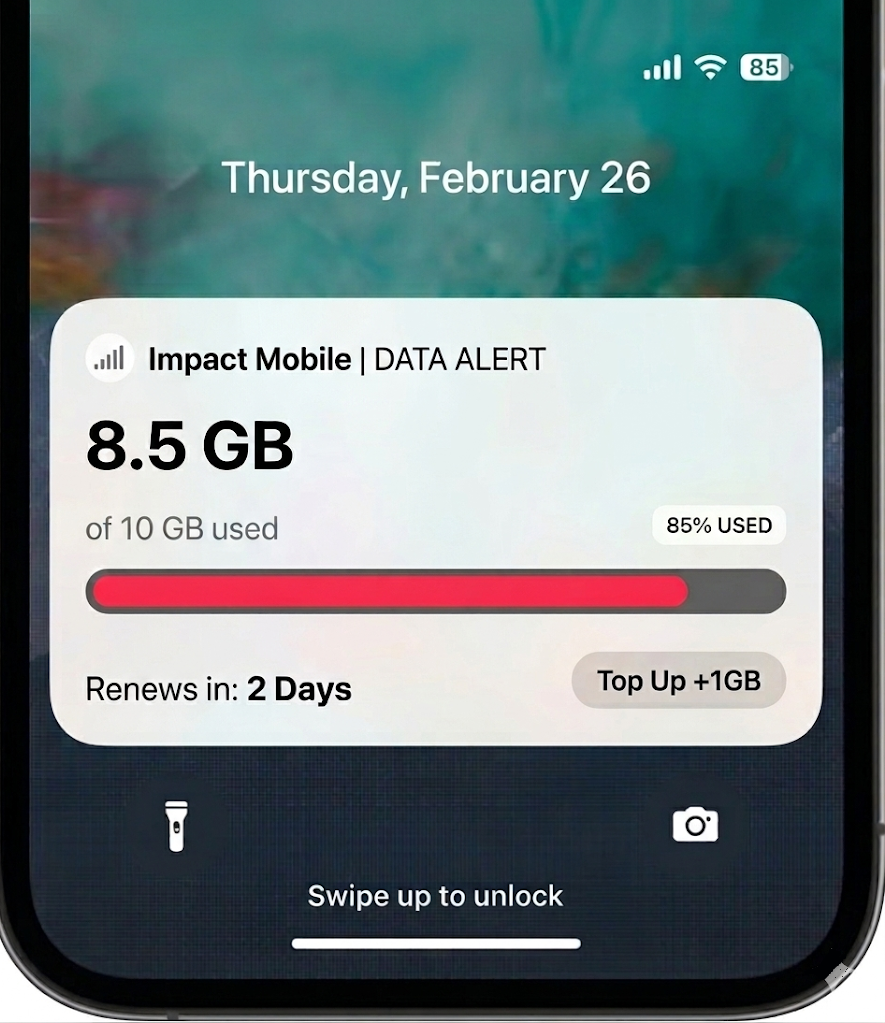
  • Plan/usage milestones (non-sensitive): Data pack status (Activated → Remaining quota) or “renewal in X days” reminders without exposing account details.

8. Gaming

  • Live match / event status: Match phase (Lobby → In game → Final) + key scoreboard updates (kills/score/objectives) in real time.

  • Timed challenges / missions: Event progress (Stage 1/3 → 2/3 → Completed) + remaining time and next milestone.

  • Queue / matchmaking updates: Queue position or estimated wait (Searching → Match found) and “reconnect”/status prompts (avoid exposing user identifiers).

9. Mobility

  • Ride status: Show the current ride phase, such as driver assigned, driver on the way, nearby, arrived, trip started, or completed.

  • Pickup progress: Display ETA, pickup point, vehicle details, and the next milestone so users can follow the ride without opening the app.

  • Trip updates: Reflect meaningful changes such as remaining time, destination progress, route changes, or delay information.

  • End condition: End the Live Activity when the driver arrives, the trip is completed, or the ride is cancelled.

Channel comparison

Dimension
Live Activities
Push Notifications
Web Widgets

Best For

  • Delivery / Courier tracking

  • Ride-hailing / Mobility

  • Live sports scores

  • Travel status

  • Fitness / Workout session

  • Gaming live events

  • Order preparation / pickup

  • Transactional updates (OTP, order/shipping, payment)

  • Cart abandonment (conversion reminder)

  • Re-engagement / inactivity (bring users back)

  • Segment-based campaigns (VIP / churn risk / interests)

  • Scheduled announcements (promo, reminder, release)

  • Geofence (location-based)

  • Page/URL based message (contextual widget)

  • Audience/ device targeting (segment, mobile/OS)

  • Scroll/Time trigger (engagement-based)

  • Feedback collection (NPS/CSAT)

  • Exit intent offer (leave prevention)

Where it appears

  • iOS glanceable surfaces (Lock screen, Dynamic Island)

  • Device notifications (Lock Screen / banners / Notification Center)

  • Website

Strengths

  • Glanceable Information

  • Real-time Updates

  • Persistent Visibility

  • Increased Engagement

  • Re-engaging Inactive Users

  • Time-Sensitive and Urgent Communication

  • Rich and Interactive Content

  • Location-Based Targeting (Geofencing)

  • No Opt-in Required

  • Highly Granular Page & Session Filters

  • Action-Driven Triggers

Choose the right channel

Use Live Activities when the user needs one persistent view of an ongoing moment.

Use push notifications when you need to alert, remind, or re-engage.

Use web widgets when you need to influence behavior during a website session.

Best Practices for Using Live Activities

Last updated

Was this helpful?